THL Resources
The NM-AIST Laboratory Services provides students with total practical skills from their theoretical background base in a conducive scientific and engineering environment. Students and Researchers are attached with a highly qualified with enough experience laboratory personnel. According to the laboratory management policy, laboratory is headed by the Laboratory Manager, assisted by Laboratory Technologists and scientists of various professional disciplines in functional units. Our lab is divided into the following sections based on the functionalities: Cyber security, Artificial Intelligence and Complexity Systems, Electronics and Telecommunication Engineering and Internet of Things and Smart Systems.
https://www.nxp.com/, https://www.st.com/content/st_com/en.html, https://www.raspberrypi.com/, https://www.arduino.cc/, https://www.ti.com/, https://aws.amazon.com/console/, https://cloud.google.com/?hl=en, https://www.hivemq.com/, https://nodered.org/, https://blynk.io/, https://thingsboard.io/, https://thingspeak.com/, https://www.mathworks.com/, https://www.espressif.com/, https://www.waveshare.com/
University
Nelson Mandela African Institution of Science and Technology
Targeted Groups
Master Students Programs: MSc students in Embedded and Mobile System (EMoS) & Information Systems and Network Security (ISNS)
Both programs; 1st & 2nd year students
THL Components
Overview of the concept and key components
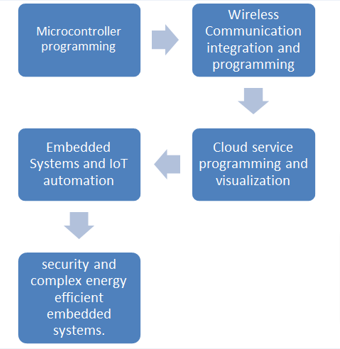
The concept is to train MSc students to design and develop the IoT-based solutions, integration of sensors and actuators for programming microcontrollers in the embedded system modules.
The module applies appropriate techniques, resources and modern tools to provide solutions for problems related to IoT and embedded engineering.
The laboratory setup for the Embedded System and Internet of Things is divided into five parts namely sensing part, wireless communication, actuation unit such as automatic heating and cooling system, power unit and controller part. In this case the microcontroller board such as ESP32, Arduino, STM32 Nucleo etc as end/intermediate node are connected to the Raspberry Pi server as a network coordinator.
The sensing part can comprises number of sensors such as temperature sensor, humidity sensor, image sensor, light sensor, water level sensor and the moisture sensor. Wireless communication made of Zigbee module to facilitate the connection between the nodes and local server (Raspberry Pi). Actuators can be for heating, cooling and actuation of the event. All mentioned parts of the embedded systems together with power are interfaced to the microcontroller unit for computational and decision making. Finally, the local servers (computer/mobile phone) and cloud server can receive the data from the sink node such Raspberry Pi.
The sink node sends and receives information to end user/cloud server using wireless communication and/or mobile internet (4G or 5G). There are two modes of operation of the system, which are auto mode and manual mode. In addition, the laboratory set-up can have two modes: auto-mode and manual-mode. In auto-mode, the system would take its own decisions and controls the installed devices whereas in manual-mode a user can control the operations of the system using an android app or PC commands.
Visual representation of use cases
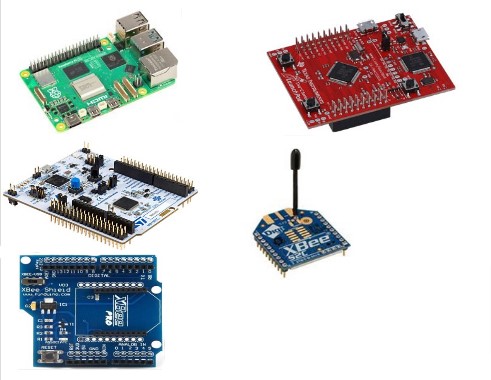
NMAIST kits
|
| UNIT NAME |
PCs |
| Raspberry Pi 5 Complete kit Quad Core 2.4GHz 64bit Cortex-A76 CPU |
5 |
| STM32 Nucleo-64 development board with STM32F401RE MCU, supports Arduino and ST morpho connectivity |
5 |
| ZigBee XBee Modules Shield V03 Modules |
2 |
| Tiva™ C Series TM4C123G LaunchPad Evaluation Board |
6 |
Training Material
View training materials
Instructions
(i) NM-AIST students and staff have access to
use the laboratory from 8:00am to 4:00pm Monday to Friday – standard working
hours
(ii)Students working in the laboratory must be
affiliated to academic staff at the department, and they have the
responsibility to make such agreements in advance.
(iii)The laboratory is also available to external
researchers during the aforementioned hours as approved and communicated by
head of department of the respective school and acknowledged by the laboratory
manager
(iv)At all times when the laboratory is in use,
laboratory personnel(s) must be available, for assistance and control
(v)Any exception granted to the aforementioned
laboratory access guideline, must be justified and abide to the guideline for
laboratory access.
(vi)Whenever access is required before and/or
after the standard working hours, it MUST be communicated in advance to the
responsible personnel and be approved by the Laboratory Manager.
(v)Students
are not allowed to bring in their laptops and install any software in the
laboratory computers.
Use cases for the labs (examples, experimentation, projects,....)
- Developing the General PurposeTimer driver
- Developing the UART transmitting and receiving drivers
- Analog to digital converter
- Developing System TickTimer Driver
- Developing the Timer Output Compare driver
- Developing GPIO Interrupt driver
- Developing the UART transmitter and receiverinterrupt drivers
- Developing the ADC interrupt driver
- Developing the Systickinterrupt driver
Curriculum
Link to the existing and planned curriculum and/or experiment categories:
MSc students in Embedded and Mobile System (EMoS) & Information Systems and Network Security (ISNS);
(Advanced Electronics (EMOS6204)-15students; Sensors & Actuator EMOS6210-10 students; IoT programming EMOS6104-10students
Adapted courses which take advantage of RL/THL equipment (Current update)
- Testing of Embedded Systems- EMoS 6301
- Embedded Systems Engineering- EMoS 6201
- Internet of Things and Embedded systems- EMOS 6104,
- Sensors & Actuators-EMOS 6210
Status of THL availability for the students
- The equipments ordered for THL purposes has been received in November 2024
- The received THL are:
- STM32 Nucleo-64 development board
- ZigBee Xbee Modules Shield
- Tiva C Series TM4C123G Lauchpad evaluation board
- Rasberry Pi 5 complete kit Quad Core 64bit Cortex-A76
- The newly received THL comes to enhance the resources we had and hence make the training and research environment much better
- The new year and semester will commence in January 2025, hence, utilization will begin during that time
Students Trained
Status Update, Training of students (examples of trainings done, ToT, workshops, ....)
- During the courses conducted in the programme, MSc EMoS, hands-on training is done for the students of the MSc first year of the Embedded and Mobile Systems programme.
- The training focuses to equip Masters students specialising in Embedded Systems specialty to develop smart-based applications using STM32 Microcontrollers and Raspberry Pi.
- Output: familiarizing students with Microcontrollers and the kit’s components
Most significant value created by having students use your lab experiments
- Solve engineering problems by proposing potential solutions using industry choice advanced Microcontrollers.
- Conduct investigations to address complex engineering problems in the areas of Embedded System
- Increase the flexibility of the teaching and learning process for both Masters' students and facilitators;
- Work individually and in a group to develop embedded systems to solve the societal problems;
- Gain skills in Development of embedded systems to suit market requirements.
Students Feedback
Pre-Survey for Take Home Labs (THLs)
Post-Survey for Take Home Labs (THLs)
Students Survey feedback and results discussion
- The implementations of the two courses, IoT and Embedded Systems and Sensors and Actuators were positively received by students.
- The devices such as TM4C123 launch pad, Raspberry Pi and NUCLEO-F4 series MCU board were distributed and shared for two students to implement their projects.
- Students had enough time to test all the devices by running simple to medium application. Also, students are enjoying working with more advanced embedded systems using the supplied MCUs.
- The students use all equipment in lab and are capable to them away from university due to their portability nature.
- Using the procured equipment and already existing ones the students will be able to extend their projects and develop more practical embedded prototypes.
Summary of THL survey results
1. Demographics Overview (Pre vs. Post)
Age:
Pre-survey: The average age of participants was approximately 22.2 years with a standard deviation of 4.93.
Post-survey: The average age slightly decreased to 21.5 years with a smaller standard deviation of 3.0.
Interpretation: The post-survey cohort is slightly younger than the pre-survey group, though the difference in average age is not very significant. The demographic composition in terms of age remained relatively consistent.
Gender:
Both surveys had a predominant male representation. This reflects a gender imbalance, which could suggest that the program either draws more male participants, or the course itself attracts students from male-dominated majors (engineering).
Major/Specialization:
Pre-survey: The students came from varied specializations including Mechanical Engineering, ICT, and Electrical Engineering, among others.
Post-survey: The distribution of majors remained similar to the pre-survey, with a notable presence of students from Mechanical and Electrical Engineering.
Interpretation: There is a consistent representation of specializations, indicating that students from similar fields participated throughout the program.
2. Previous Lab Experience (Pre vs. Post)
Pre-survey: A notable portion of students reported prior lab experience, ranging from basic electrical and electronics labs to hands-on and e-learning labs. Some students indicated having experience in specialized areas such as Huawei’s HCIA certification labs.
Post-survey: Students reported diverse previous experiences including electrical, electronics, and computer labs. Some students who mentioned take-home labs previously might have been familiar with similar learning environments.
Interpretation: Prior lab experience did not seem to shift much, but the experience likely helped students navigate the THLs more easily. This could be reflected in their generally positive feedback in the post-survey.
3. Learning Preferences (Pre-Survey) vs. Feedback for Improvement (Post-Survey)
Pre-survey (Learning Preferences):
Students preferred a variety of learning methods, with hands-on methods and visual learning being the most prominent. There was also mention of combining visual aids with internet resources.
Post-survey (Feedback for Improvement):
Several students requested more detailed feedback after tasks were completed, suggesting a desire for more interactive learning opportunities.
Some feedback suggested improving infrastructure (e.g., better internet connectivity). However, most participants seemed satisfied, with a few students mentioning that no significant improvements were needed.
Interpretation: The THLs appear to have mostly met the students’ expectations regarding their learning preferences. However, the feedback highlights a need for better task feedback and some improvements in infrastructure for remote students, aligning with what many students anticipated in their initial concerns.
4. Anticipated Challenges (Pre-Survey) vs. Reported Feedback (Post-Survey)
Pre-survey (Anticipated Challenges):
Students anticipated several technical challenges, including internet connectivity issues and problems with technical equipment (e.g., Raspberry Pi). Others mentioned concerns related to problem-solving when tasks didn’t work as expected.
Post-survey (Reported Feedback):
Post-survey feedback corroborated some of the anticipated issues, especially around internet connection and technical difficulties, though many students did not face as severe challenges as anticipated. A few responses indicated that the labs were “great” with no significant issues reported.
Interpretation: There was an alignment between anticipated and encountered challenges, particularly related to infrastructure and connectivity issues. However, the overall tone of the post-survey feedback suggests that many students were able to overcome these challenges successfully or found them less problematic than expected.
5. Thematic Analysis of Open-Ended Feedback (Pre vs. Post)
Pre-survey Comments:
Many students expressed optimism and enthusiasm, with comments focusing on the novelty of the remote and take-home labs. Some students expected the THLs to provide a more hands-on experience, which they believed would improve their learning.
Post-survey Comments:
The majority of comments in the post-survey were positive. Some students appreciated the interactivity and convenience of the THLs, mentioning that they would recommend using remote labs more often. The feedback suggests that students found the labs to be a valuable learning experience, although some requested more interactivity and feedback on tasks.
Interpretation: The open-ended feedback from both surveys highlights the value students placed on hands-on learning. The post-survey feedback suggests that the THLs largely met students' expectations, though there were some requests for increased interactivity and feedback.
Conclusion:
The comparative analysis between the pre-survey and post-survey data suggests that the Take Home Labs (THLs) were successful in addressing most of the students' learning preferences and overcoming anticipated challenges. The majority of students had a positive experience, with requests for minor improvements in terms of infrastructure and task feedback.
Consistencies: The demographic composition remained consistent throughout the program. The learning preferences and challenges anticipated in the pre-survey largely matched the experiences reported in the post-survey.
Improvements: Feedback after task completion and the need for better internet connectivity were mentioned as areas for improvement. Addressing these aspects would further enhance the THLs experience.
Overall, the students’ feedback reflects satisfaction with the learning approach and suggests that the THLs provided a beneficial hands-on learning opportunity that met their academic expectations.
Instructors/staff Feedback
Didactical needs
- Ensuring that the instructions are clear, so students can complete the tasks at home
- Required tasks should be related to the topics covered in lectures
- Clear assessment criteria to ensure students understand how their work will be evaluated
Obstacles or limitations
- The TL equipment are to enough for all students. As a result they have to share them.
- At this time we procured only limited equipment such as MCUs and Raspberry PIs. However, to enhance the teaching and learning process there is a need to have other devices such sensors, actuators, wireless modules, display modules etc.
Lessons Learned
Having these TL equipment we manage to break the gap between theories and practicals. Currently, our students mainly focus with practical oriented scenarios by developing embedded and IoT systems.
Also, we enhanced more resouces sharing among the students due to the limited devices.
Contact Information
Email: labmager@nm-aist.ac.tz
Number: +255769551025
Photos