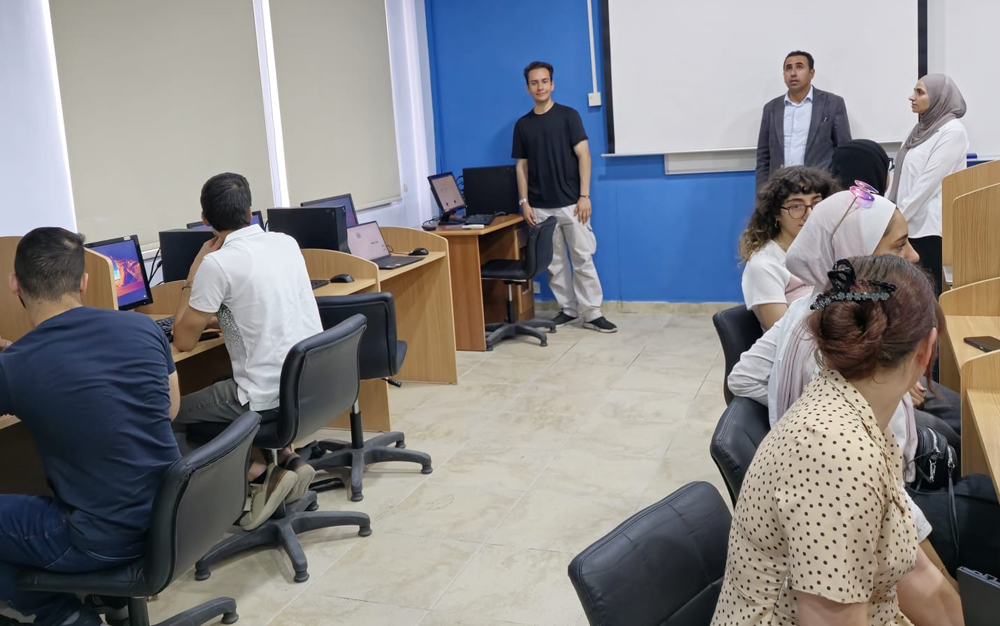
IoT lab
THL Resources
This lab has been established to provide students with IoT environment, which include necessary IoT equipment that enable students to design, test, and build their IoT projects. Equipment list include:
- Starter Kits, (UNO R3, MEGA 2560, NANO V3, and the ESP32 WiFi + Bluetooth Development Board and the ESP8266 Node MCU).
- Starter Kits (Uno R3, Mega 2560, Nano V3, ESP8266 Node MCU & Uno R3 Wi-Fi Board, ESP32 Dual WiFi + Bluetooth Developer Board).
- Raspberry Pi 4 Model B – 2GB RAM
listed at the following link:
https://www.uop.edu.jo/En/OfficeOfExternalFunding/Documents/FITIOTLab.pdf
University
University of Petra
Targeted Groups
Faculty students (Computer Science, Software Engineering, Information Security, and Data Science & Artificial Intelligence Departments)
Lab Link
https://www.uop.edu.jo/En/OfficeOfExternalFunding/Documents/FITIOTLab.pdf
THL Components
Overview of the concept and key components
- GAR Monster Starter Kit for Arduino
- GAR Colossus Starter Kit for Arduino
- Gar 1000 Robots in industry
- Raspberry Pi 4 Model B – 2GB RAM
- Raspberry Pi Camera Module 3
- Docker Training
Training Material
Instructions
Students can use the Lab equipment to implement courses’ projects, prototype graduation projects, IoT training course at Innovation Center.
View training materials
Curriculum
Link to the existing and planned curriculum and/or experiment categories:
Introduction to IoT Course (601318), Robots Programming Course (606417), Network Monitoring Course (605365), Intrusion Detection & Prevention Course (605443)
Students Trained
Most significant value created by having students use your lab experiments
Design, build, and test IoT projects, robot projects, and Cybersecurity Training Labs
Students Feedback
Pre-Survey for Take Home Labs (THLs)
Post-Survey for Take Home Labs (THLs)
Instructors/staff Feedback
Didactical needs
- Optimize the learning experience, it is essential to provide structured and systematic lab sheet instructions that guide students through the implementation of required practical tasks.
- A strong emphasis should be placed on ensuring that theoretical concepts are seamlessly integrated with practical applications, fostering a holistic understanding of the subject matter.
- Encouraging collaborative, project-based learning will enhance teamwork, critical thinking, and problem-solving skills.
- Establishing clear and transparent assessment criteria is crucial to ensure fairness and consistency in evaluating student performance.
Obstacles or limitations
- High enrollment numbers pose logistical challenges in managing resources and maintaining engagement.
- Varied self-paced learning approaches among students make it difficult to maintain uniform progress.
- Limited availability of IoT kits and the need for regular maintenance can hinder hands-on learning opportunities.
- Evaluating individual contributions in group-based projects remains a challenge, necessitating robust assessment mechanisms.
Lessons Learned
- New avenues for student engagement and innovation:
- Opportunities for students to work on real-world projects, enhancing their practical experience and employability.
- A platform for creative students to develop and showcase their innovative ideas.
- A chance for IT students to apply their programming expertise in designing and developing embedded systems, reinforcing their technical skills in a practical setting.
Contact Information
Email: amaqousi@uop.edu.jo
Photos
Cybersecurity lab
THL Resources
This lab has been established to provide students with a comprehensive environment tailored for cybersecurity education and hands-on practice. It is equipped with the necessary tools and equipment to enable students to design, test, and build projects focused on various aspects of cybersecurity.
Equipment list include:
- A powerful server with 250GB storage and 32 thread processors to handle intensive computing tasks.
- High-speed internet connection with 100Mbps fiber to ensure fast and reliable connectivity.
- 25 computers connected via LAN networks to facilitate collaborative work and resource sharing.
- A range of operating systems including Windows 10, Kali Linux (running on VMware), Docker, and Kubernetes (K8s) to support diverse project requirements and provide a robust learning platform.
listed at the following link:
https://www.uop.edu.jo/En/OfficeOfExternalFunding/Documents/FITIOTLab.pdf
University
University of Petra
Targeted Groups
Faculty students ( Information Security Departments)
THL Components
Overview of the concept and key components
Laptop
Docker Training
Training Material
Lab sheets
Instructions
Students can use the Lab equipment to implement courses’ projects such as network monitoring course, Ethical Hacking course and Data analytic (SOC) course.
View training materials
Curriculum
Students Trained
Status update of Training materials
Most significant value created by having students use your lab experiments
Students feedback
Pre-Survey for Take Home Labs (THLs)
Post-Survey for Take Home Labs (THLs)
Contact Information
Email: amaqousi@uop.edu.jo / mohammad.alauthamn@uop.edu.jo
Photos